
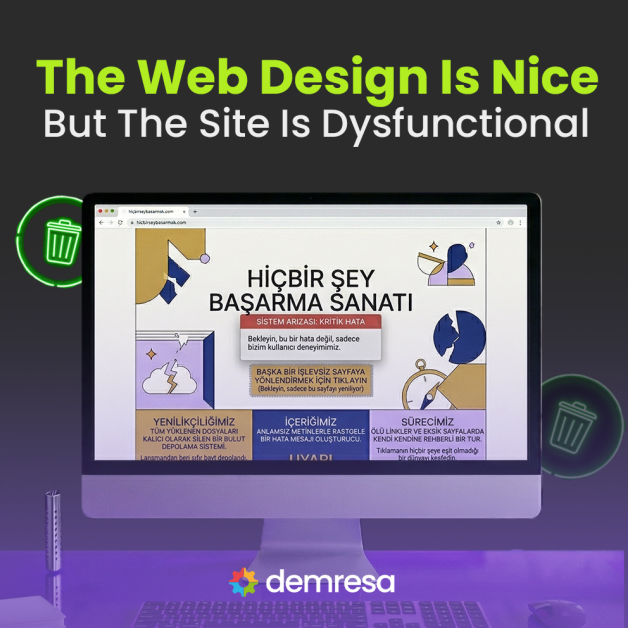
WHY IS IT NOT ENOUGH FOR A DESIGN TO BE LIKED?
One of the most common misconceptions in web design processes is the assumption that a website that is aesthetically pleasing is automatically successful. However, in the digital world, success is measured not by visual appeal, but by the results achieved. A design that users find “beautiful” is not functional if it does not generate action. For this reason, the concepts of aesthetics and performance should be clearly separated.
An aesthetic design may attract the user to the site, but it does not guide them. If the user does not understand what to do after entering the site, conversion will not happen no matter how impressive the design is. This clearly demonstrates the difference between visual appeal and business generation.
The Difference Between Aesthetics and Results
A good-looking design does not necessarily mean a design that generates business. Success is measured by whether the user takes action.
When user behavior is analyzed, it becomes clear that visitors spend only a very short time evaluating a site. During this time, the user focuses not only on the design, but also on content, guidance, and clarity. If these elements are missing, the user leaves the site.
In addition, aesthetically focused designs often leave user experience in the background. Structures that are visually dense but weak in guidance disconnect the user from the process. This directly reduces the functionality of the design.
The purpose of design is not only to attract attention, but to guide the user toward a specific goal. This goal may be making contact, requesting a quote, or making a purchase. If the design does not support this goal, it remains only a visual presentation.
On corporate websites, the success of design should be evaluated by how effectively it guides the user. When this approach is adopted, aesthetics and functionality progress in a balanced way.
Visual quality creates the first impression for the user, but it does not determine the decision-making process on its own. The user wants to understand what they see and move forward. For this reason, the design must be clear and guiding.
In this direction, design should be treated as a business tool beyond aesthetics. Structures that guide the user and produce results are what truly define successful design.
WHY DOES THE USER GET LOST ON THE SITE?
One of the most common problems users experience on websites is not knowing what to do within the site. This indicates that the user experience is weak and that the guidance mechanism has not been structured correctly. The user comes to the site with a specific purpose and wants to see a clear path to reach that goal. When that path is not provided, the user gets lost and leaves the site.
Lack of guidance is a critical factor that directly affects user behavior. When the user does not understand which page they are on, where they should go, and which step they need to take, the process breaks down. This disruption causes the visitor to become passive and leave without taking action.
Lack of Guidance
When the user is not presented with a clear path, the site becomes complex. Structures without clear guidance cause the user to get lost.
The fact that the content within the site is disconnected from one another also increases this problem. If the user cannot find a logical flow while moving from one page to another, they struggle to understand the site. This weakens the user experience and reduces on-site navigation.
In addition, unclear action points are also an important factor. If the user cannot find an answer to the question “What should I do?”, they will not move forward. For this reason, every page should contain clear action areas that guide the user.
An imbalance in visual and content density also makes things harder for the user. Too much information or unnecessary detail tires the user and makes it difficult to focus. This distances the user from the process.
In terms of user experience, simplicity and clarity are of great importance. When the user can move through the site comfortably, they reach the information they are looking for more quickly and the likelihood of taking action increases.
The site structure should be planned in line with the user journey. Each page should support the transition to the next step. When this structure is not established, the user gets lost within the site.
For this reason, website design should be structured with a system that guides the user and provides flow. When a clear and understandable experience is presented, user loss is significantly reduced.
WHY DOES VISUAL DENSITY CAUSE HARM?
In web design, visuals are an important tool for attracting user attention and strengthening the message. However, when this tool is not used correctly, it can turn into the greatest weakness of the design. Designs based on excessive visual use distract users instead of impressing them and make it harder for them to focus. This directly affects the user experience negatively.
When the user enters the site, they want to reach certain information. If the page contains too many visuals, animations, or distracting elements, the user struggles to find that information. This tires the user and may cause them to leave the site. Visual density becomes a serious obstacle, especially in the decision-making process.
Distribution of Attention
Excessive use of visuals scatters the user’s focus. Loss of focus slows down the decision-making process and reduces the likelihood of taking action.
The purpose of visuals is to guide the user and support the message. However, when this balance is not achieved, visuals move ahead of the main content. The user does not know what to focus on and gets lost on the page. This reduces the functionality of the design.
In addition, heavy visuals and animations also negatively affect site performance. Longer page loading times reduce user patience and increase abandonment rates. From a technical perspective, this also means a serious performance loss.
Visual density also lowers content readability. If the user cannot maintain a balance between text and visuals, the content becomes difficult to understand. This weakens the user experience and reduces the likelihood of conversion.
Simplicity in design is of great importance for user experience. The user wants to move forward within a clear and understandable structure. For this reason, visuals should only be used where necessary and for the right purpose.
In a properly structured design, visuals serve as elements that guide the user and support the content. When this balance is achieved, the design becomes both aesthetic and functional.
For this reason, balance should be maintained in the use of visuals and a structure that protects user focus should be established. The right visual strategy directly improves design performance.
WHY IS MOBILE USAGE OVERLOOKED?
One of the most critical mistakes in web design processes is evaluating the mobile user experience as secondary. However, today a large portion of users access websites through mobile devices. Despite this, many designs are structured with a desktop-first mindset and the mobile experience is not optimized sufficiently. This causes serious user and conversion loss.
When real usage habits are analyzed, it becomes clear that users expect a fast, practical, and simple experience. On mobile devices, complex structures, small buttons, and content that is difficult to read directly affect the user negatively. The user does not want to continue with an experience that feels difficult and leaves the site.
Actual Usage Habits
A large portion of users access websites from mobile devices. Sites with a weak mobile experience lose a significant part of their potential users.
Another reason mobile design is overlooked is the belief that the desktop experience is sufficient. However, user behavior does not support this approach. The user often has their first interaction with the site through a mobile device. If this first experience is negative, the user may never return.
In addition, attention span is shorter on mobile devices. The user wants to reach information quickly. Long and complex content is not suitable for mobile users. For this reason, the content structure should be optimized for the mobile experience.
The navigation structure also becomes critical on mobile. Menus that are difficult to use and complex page transitions tire the user. This pushes the user to leave the site.
Performance is also an important part of the mobile experience. Slowly loading pages reduce user patience and increase abandonment rates. For this reason, mobile performance should be optimized.
A mobile-friendly design does not simply mean adapting to screen size. It is necessary to offer an experience that fits user behavior. This approach increases user satisfaction and conversion rates.
For this reason, web design should be approached with a mobile-first strategy. When a structure that fits user habits is established, site performance and conversion rates increase significantly.
WHAT DOES “PROFESSIONAL APPEARANCE” NOT MEAN?
In web design processes, the concept of “professional appearance” is often misinterpreted. Many companies think they have created a professional website by using modern graphics, dense animations, and stylish visuals. However, professionalism is not a concept measured only by visual quality. True professionalism is determined by the quality of the experience offered to the user.
The basis of this misconception is the dominance of an aesthetics-focused approach. However, the user looks for clarity, speed, and trust beyond visual elegance. If the site does not meet these needs, it will not be perceived as professional no matter how well designed it looks.
Misconception
Professional appearance is not only about aesthetics. Designs that do not guide the user and do not build trust are not considered professional.
Excessive use of effects is also a result of this misconception. Too many animations, transition effects, and moving structures may tire the user instead of impressing them. The user wants to see a simple and understandable structure. Complex designs weaken the perception of professionalism.
Content quality is also an important part of professionalism. Generic, superficial, and repetitive content does not build trust with the user. The user wants to feel that the structure in front of them is expert. This feeling is created through the right content.
In addition, consistency throughout the site is also important. Using different design languages on different pages creates confusion for the user. A professional structure should offer a holistic and consistent experience.
Clear action areas presented to the user are also a sign of professionalism. If the user knows what to do and can move forward easily, the site is perceived as professional.
Professionalism means establishing a structure that provides value to the user and makes the process easier. When this approach is adopted, the design gains real functionality.
For this reason, professional appearance should be treated as a structure that includes functionality together with aesthetics. User-focused designs create the true perception of professionalism.
WHAT DOES A DESIGN THAT GENERATES RESULTS LOOK LIKE?
A web design that generates results is not only aesthetically strong, but also a structure that guides the user toward a specific action. In this approach, design ceases to be a presentation tool and becomes a direct part of the business generation process. From the moment the user enters the site, they are guided and clearly see what they should do at every step of the process.
An action-focused structure begins with clearly planning the user journey. The steps the user will go through from the moment they enter the site should be determined, and this flow should be supported by design. When this structure is not established, the user remains uncertain and the process does not move forward.
Action-Focused Structure
A design that generates results is one that guides the user and enables action. Every page should support the transition to the next step.
The harmony between content and design forms the foundation of this process. The message presented to the user should be clear, understandable, and goal-focused. Complex or ambiguous content drives the user away. Clear messages, on the other hand, accelerate the decision-making process.
Correct positioning of action areas is also critically important. The user should be able to easily see what they need to do and at which point. The visibility and clarity of these areas increase conversion rates.
Trust elements must be placed correctly within the design. When the user feels trust in the structure in front of them, the likelihood of taking action increases. For this reason, the design should be strengthened with elements that support trust.
Technical performance is also an important part of a design that generates results. A structure that loads quickly, works without errors, and remains stable strengthens the user experience. This keeps the user engaged in the process.
A continuous analysis and improvement approach increases the performance of the design. User behavior should be monitored, the design should be optimized, and weak points should be improved. This process ensures sustainable success.
Web designs created in this direction generate not only appearance, but performance. Structures that guide the user correctly make it easier to achieve business goals.
